
An AI photo-selection workflow gives you your weekends back by cutting hours of culling to minutes. Lenzeit automatically rejects blurry and duplicate frames and groups keepers by person, so selection is no longer the bottleneck.
It’s Sunday afternoon. The sun is shining, your friends are at a barbecue, and your family is heading to the park. Where are you? You’re in a dark room, staring at image number 2,491 of 6,000, trying to decide if the bride’s eyes are slightly more open in frame A or frame B.
This is the reality for thousands of event photographers. We trade our weekends to shoot the event, and then we trade our weeknights to select (or 'cull') the photos. It’s a recipe for burnout, strained relationships, and a business that feels more like a prison than a passion.
But what if the selection process the most tedious part of the job could be done for you while you sleep? In this guide, we’ll explore the AI workflow that is giving photographers their lives back.
The Math of Manual Selection: Why You're Losing Money
Most photographers calculate their earnings based on their shooting time. 'I charge $3,000 for 10 hours of shooting, so I make $300 an hour.' Wrong.
The hidden killer is the 'sorting Tax.' For a typical wedding with 4,000-6,000 raw images, manual selection takes an average of 6 to 10 hours depending on your speed and decisiveness. That brings your hourly rate down significantly. More importantly, it creates a backlog. If you shoot back-to-back weddings on Friday and Saturday, you start Monday with 12,000 photos to sort. You are already behind before the week starts.
⚠️ Decision Fatigue is Real
After making 1,000 micro-decisions about focus and expression, your brain gets tired. You start keeping mediocre photos 'just in case,' which bloats the final gallery and lowers your perceived quality.
The AI Workflow: How It Works
AI photo selection isn't about letting a robot pick your art. It’s about letting a supercomputer handle the objective technical analysis so you can focus on the subjective emotion.
Step 1: The 'Technical Pass' (Automated)
Tools like Lenzeit use computer vision to instantly analyze every pixel of your 6,000 images. In minutes, the AI identifies:
- ✓Focus Accuracy: Is the eye sharp?
- ✓Exposure Issues: Is it blown out or crushed black?
- ✓Blink Detection: Are the subject's eyes closed?
Step 2: The 'Grouping Pass' (Automated)
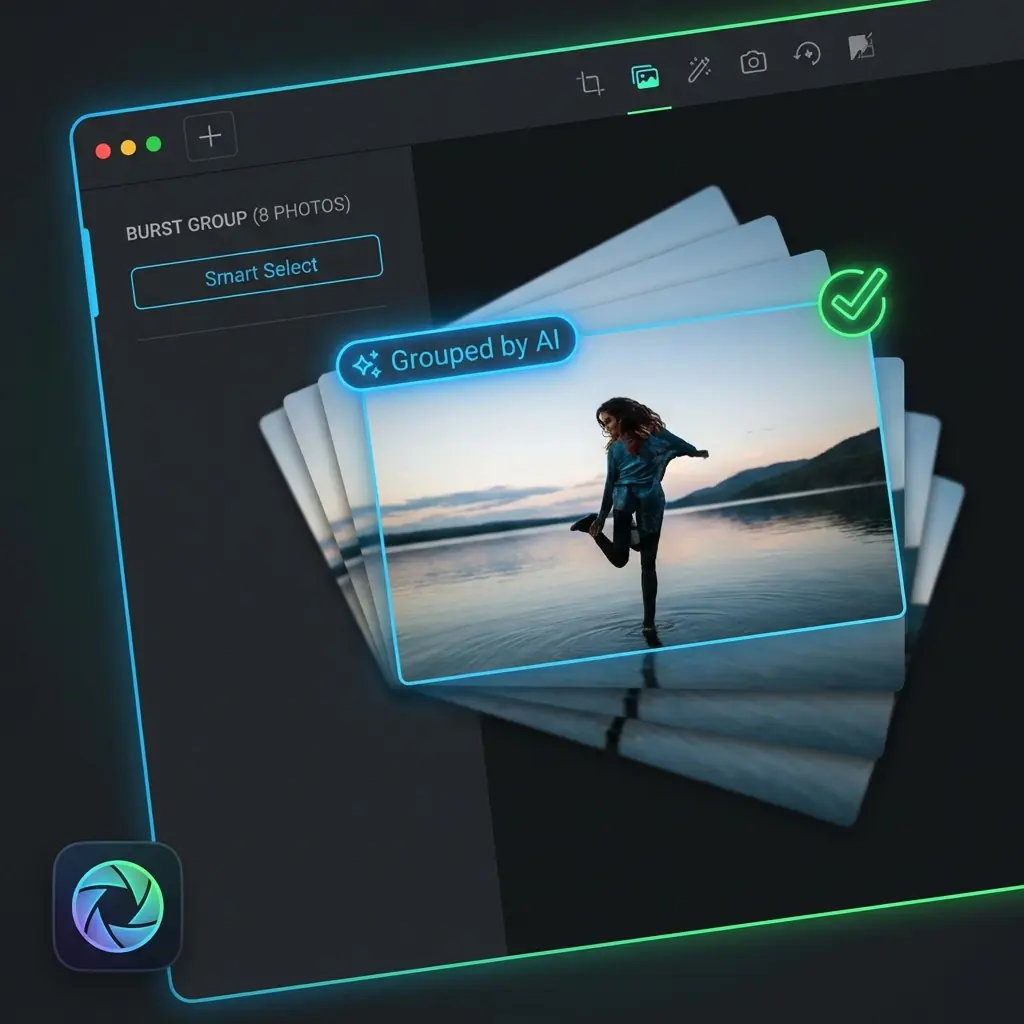
This is where the magic happens. You took 10 frames of the first kiss in burst mode. You don't need to see all 10 side-by-side. The AI groups them into a single stack and presents the 'Best Shot' (sharpest, eyes open, best composition) on top. You can still see the others if you want, but 90% of the time, the AI is right.
Reclaiming Your Weekend: A Case Study
Let’s look at a real-world comparison of the 'Old Way' vs. the 'Lenzeit Way' for a Saturday wedding.
- The Old Way: You get home at midnight. You sleep. Sunday morning, you start importing. You spend Sunday from 10 AM to 6 PM sorting. You are exhausted. You miss your family dinner.
- The Lenzeit Way: You get home at midnight. You start the upload to Lenzeit. You go to sleep. The AI processes the photos overnight. Sunday morning, you wake up to a curated gallery of 'Best Shots.' You spend 30 minutes verifying the selections. You are done by 10:30 AM. You go to the beach.
✅ The 'Fresh Eyes' Advantage
When you don't spend hours looking at bad photos, you have more creative energy to edit the good ones. Your color grading and retouching improve because you aren't burned out.
It’s Not Just About Time; It’s About Speed to Market
Speed impresses clients. Delivering a full gallery on Tuesday instead of 'in 6-8 weeks' blows their minds. It leads to better reviews, more referrals, and the ability to charge premium 'Rush Delivery' fees without doing extra work.
Stop wearing your burnout as a badge of honor. The technology exists to give you your life back. Let the AI handle the selection, so you can handle the living.